Transitioning Casual Fits from Spring to Summer: Linen Blends
Advertisements
Smart linen-blend layering tactics can make the spring-to-summer transition easier by combining lightweight garments that can be added or removed throughout the day.
Instead of relying on heavy outerwear, breathable shirts, relaxed blazers, lightweight cardigans and compact accessories provide flexibility during cool mornings and warmer afternoons.
The key is choosing each blend by its actual fiber composition, weight and construction rather than assuming every garment labeled “linen blend” performs identically.
Why Linen Blends Work for Transitional Dressing
Linen is made from flax and is valued for ventilation, moisture absorption, strength and the characteristic texture associated with warm-weather clothing.
When blended with another fiber, its feel, drape, drying behavior, wrinkle tendency and durability can change considerably depending on composition and construction.
This makes linen blends useful transitional options, but the best fabric depends on what you expect from the garment and how you plan to wear it.
Not Every Linen Blend Feels the Same
A linen-cotton blend can feel familiar and structured, while linen-viscose combinations often create a softer drape and more fluid movement.
Blends containing synthetic or man-made cellulosic fibers may change wrinkle behavior, stretch, drying time, breathability and overall hand.
Always check the fiber-content label rather than choosing solely from the words “linen blend” printed in a product description.
Fabric Construction Matters Too
Fiber composition alone does not determine comfort because weave density, garment weight and lining substantially affect airflow and how clothing feels against the body.
A loosely constructed lightweight fabric will usually behave differently from dense tailoring even when both contain a similar percentage of linen.
This matters during spring-to-summer layering, where the goal is adding temporary coverage without unnecessary bulk or trapped heat.
Layering Tactic 1: Choose a Lightweight Linen-Blend Blazer
A lightweight linen-blend blazer can provide enough structure for cool mornings, offices and evening plans without the weight of traditional cold-weather tailoring.
It works particularly well over a simple T-shirt, tank or lightweight knit, allowing the base layer to stand alone once temperatures rise.
For maximum versatility, prioritize comfortable movement and construction that does not make the blazer substantially warmer than necessary.
Keep the Construction Light
An unlined or partially lined blazer can feel noticeably lighter than one containing a full lining and substantial internal structure.
Relaxed tailoring also leaves more space between garment and body, helping the outfit feel less restrictive as temperatures change.
This gives casual clothing a polished finish without turning a practical transitional layer into a heavy formal jacket.
Start With Easy Neutral Colors
Stone, cream, beige, navy and muted blue can pair easily with denim, shorts, skirts and trousers already present in a casual wardrobe.
Neutral does not have to mean plain because linen's characteristic surface texture can create interest even when the color palette remains restrained.
Readers building around relaxed silhouettes can also explore these casual athleisure trends for additional outfit combinations.
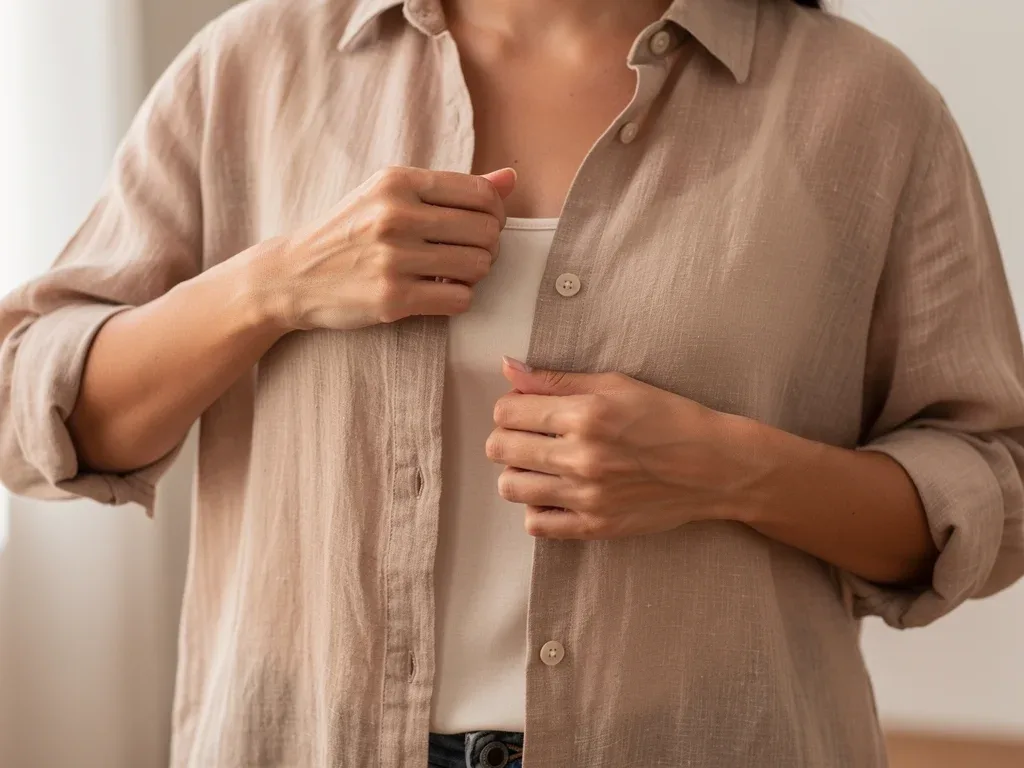
Layering Tactic 2: Wear an Open Linen-Blend Shirt
An open button-front shirt is one of the simplest transitional layers because it can be worn over tanks, tees and lightweight dresses.
Leaving the shirt unbuttoned allows more air circulation while adding coverage, making it useful during breezy mornings and air-conditioned interiors.
Once temperatures climb, the same shirt can be removed, tied loosely or carried without occupying the space of a heavier jacket.
Build the Outfit Around a Simple Base
A fitted tank and relaxed trousers create a clean foundation that lets an open linen-blend shirt add texture without making the outfit complicated.
The same idea works with denim shorts, skirts or a simple slip-style dress depending on the setting and desired level of polish.
Keeping the base uncomplicated makes the removable outer layer feel intentional rather than like an extra garment added only for weather changes.
Use Proportion to Keep the Look Balanced
An oversized shirt usually works best when another part of the outfit provides definition through a cleaner waistband or more fitted base layer.
A shorter shirt can pair easily with wide-leg trousers, while longer styles create more coverage over shorts or fitted silhouettes.
There is no universal proportion rule, but balancing relaxed and structured elements can make transitional casual outfits easier to style.
Layering Tactic 3: Add a Lightweight Cardigan or Kimono
A linen-blend cardigan or kimono offers softer structure than a blazer while providing additional coverage when temperatures fall after sunset.
The relaxed silhouette makes this tactic particularly useful with dresses, sleeveless tops and wide-leg trousers during transitional weather.
Choose a genuinely lightweight fabric because a dense knit containing linen may still feel considerably warmer than a loose woven summer layer.
Use a Cardigan for More Structure
A short cardigan can define the upper body and works especially well over dresses, tanks or high-waisted trousers without covering the entire outfit.
Buttons provide several styling options, from fully open to partially fastened when a little more warmth is needed.
Check the complete fiber composition because cotton, viscose, lyocell and synthetic components can alter stretch, drape, drying behavior and feel.
Use a Kimono for Airier Coverage
A kimono-style layer creates movement and visual interest while remaining relatively easy to remove as the day becomes warmer.
Longer silhouettes work particularly well over simple monochromatic bases because the flowing layer becomes the main decorative element.
Avoid assuming that loose shape alone guarantees coolness, since heavy fabric or dense construction can still make an oversized layer uncomfortable.
Layering Tactic 4: Keep a Lightweight Wrap or Scarf Nearby
Compact accessories provide another way to adapt an outfit without committing to a complete outer garment throughout the entire day.
A lightweight linen-blend scarf or wrap can provide temporary shoulder coverage during travel, outdoor dinners or strongly air-conditioned environments.
When it is no longer needed, the accessory can usually be folded into a tote more easily than a jacket or substantial cardigan.
Use Accessories for Styling, Not Guaranteed Sun Protection
A scarf placed over the head or shoulders provides physical coverage, but ordinary fashion fabric should not automatically be described as certified UV protection.
Reliable ultraviolet protection depends on factors including fabric density, color, construction, coverage and whether the textile carries a tested UPF rating.
Use linen-blend accessories primarily for adaptable styling and coverage rather than presenting them as substitutes for established sun-protection measures.
Choose Accessories That Serve More Than One Role
A large scarf can function as a shoulder wrap, hair accessory or decorative element depending on its dimensions and fabric behavior.
A lightweight tote can carry removed layers while reinforcing the relaxed texture associated with spring and summer dressing.
For more ideas on finishing an outfit, these casual accessories offer additional ways to create visual interest without excessive layering.
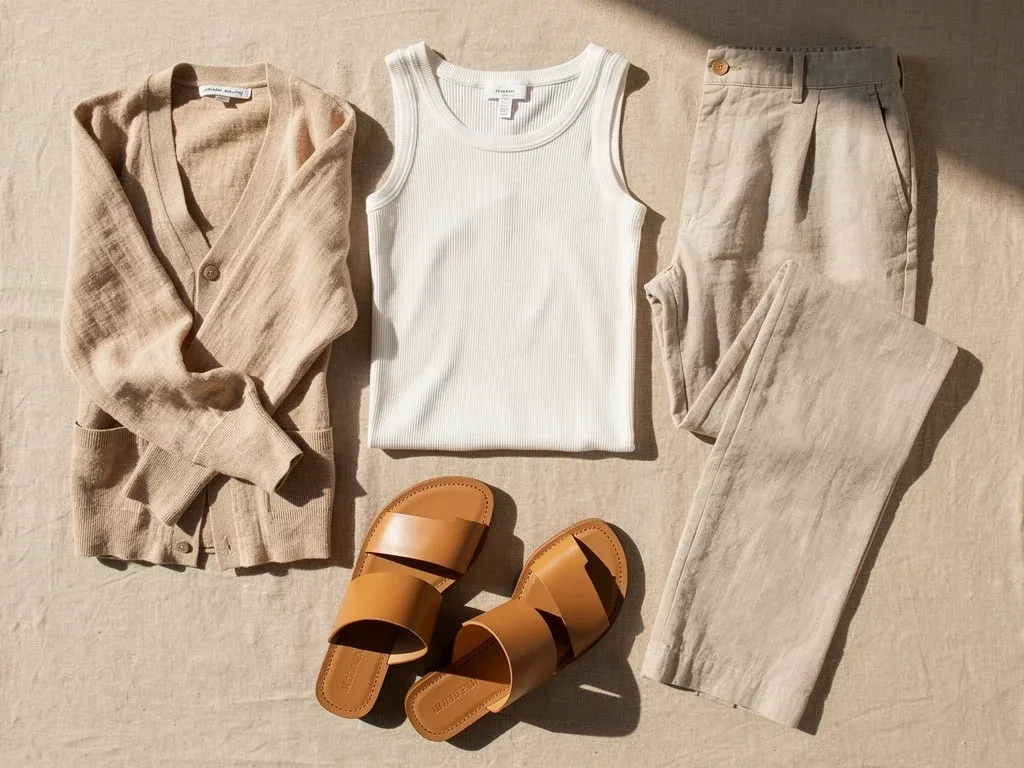
Build the Outfit From the Lightest Layer Outward
Transitional dressing becomes easier when the innermost garment can function comfortably on its own after every outer layer has been removed.
Start with a tank, tee or lightweight shirt, then add only the amount of coverage needed for the coolest part of the day.
This prevents the common problem of removing a blazer or cardigan only to discover that the base outfit was never designed to stand alone.
Think in Removable Layers
Every outer component should be easy to remove without requiring the entire outfit to be restyled in a restroom or changing area.
Open shirts, simple blazers and lightweight cardigans work well because they can disappear from the outfit without affecting the basic silhouette.
This is more practical for seasonal transitions than stacking several dependent pieces that only make sense when worn together.
Choose Fiber Composition According to Your Priorities
A useful linen blend should solve a specific wardrobe need, whether that is softness, structure, easier care or a particular type of drape.
Cotton, viscose, lyocell and synthetic fibers contribute different properties, meaning two similarly priced linen-blend garments may perform very differently.
Checking percentages gives you more useful information than assuming a small amount of linen automatically provides the character of a mostly linen garment.
Linen and Cotton Can Create Familiar Structure
Cotton and linen are both plant-derived fibers frequently combined in shirts, trousers, dresses and casual tailoring designed for warm-weather wardrobes.
The exact hand and performance still depend on fabric construction, but the combination can balance linen's texture with familiar cotton characteristics.
Evaluate the actual garment rather than assuming a specific fiber percentage will always produce the same result across brands and weaves.
Linen and Viscose Can Create More Fluid Draping
Viscose or rayon can introduce softness and movement, making these blends common in relaxed trousers, flowing shirts and lightweight dresses.
The resulting garment may feel considerably less crisp than traditional linen, which can be useful when a softer silhouette is preferred.
Care requirements may also change, reinforcing why composition labels and manufacturer instructions matter when comparing otherwise similar garments.
Do Not Assume Linen Blends Are Wrinkle-Free
Wrinkling is part of linen's familiar character, and mixing fibers may alter creasing without guaranteeing a permanently smooth garment.
The result depends on fiber percentages, weave, finishing treatments and how the piece is washed, dried, packed and worn.
Anyone shopping primarily for wrinkle resistance should assess the specific garment instead of relying on “linen blend” as an easy-care promise.
Embrace Some Natural Texture
A slightly relaxed surface often suits casual spring and summer dressing and does not necessarily mean that the garment is poorly maintained.
Trying to preserve a perfectly pressed appearance can also make linen-based clothing less convenient than its relaxed aesthetic is intended to be.
If a smoother finish matters, steam or press the garment according to its care instructions shortly before wearing it.
Create a Small Spring-to-Summer Capsule
You do not need a separate wardrobe for every temperature shift if several garments can perform multiple roles across the season.
A shirt, lightweight blazer, relaxed trousers and simple base layers can create numerous combinations with footwear and accessories you already own.
This approach also makes outfit planning easier because each new purchase must coordinate with several existing garments before entering the wardrobe.
Start With Three or Four Useful Pieces
Begin with one open shirt, one pair of trousers and either a blazer or cardigan based on how formal your normal routine is.
Add shorts, skirts or a dress only when they fill a genuine gap rather than purchasing an entire linen-themed collection at once.
The goal is adaptability, not replacing functional clothes simply because a particular fiber becomes popular during warmer months.
Sustainability Depends on More Than Linen Content
Linen comes from flax, but fiber origin alone does not determine the complete environmental or social performance of a finished garment.
Farming, fiber preparation, spinning, weaving, dyeing, finishing, transportation, manufacturing, consumer care and end-of-life treatment all influence its footprint.
A blend can also combine fibers from different supply chains, making simplistic “linen equals sustainable” claims inappropriate for responsible shopping advice.
Longevity Can Be More Useful Than Trend Labels
A garment worn repeatedly across several years can provide greater wardrobe value than a supposedly sustainable item purchased for one seasonal trend.
Check seam quality, fabric opacity, button attachment and whether the garment still coordinates with clothes you expect to keep wearing.
A versatile wardrobe can also work alongside newer tools such as AI personal stylists for casual fashion without requiring constant replacement.
Care for Linen Blends According to the Label
There is no single washing rule that safely covers every linen blend because secondary fibers, dyes, trims and garment construction can alter care requirements.
Many linen garments tolerate gentle machine washing, while certain tailored, lined or specially finished pieces may require different treatment.
The manufacturer's care label should therefore take priority over generic washing instructions found in fashion guides.
Gentle Washing Is Often a Practical Starting Point
When machine washing is permitted, a mild detergent and appropriate cycle can reduce unnecessary mechanical stress on fabric and garment construction.
Wash similar colors together and avoid using aggressive bleaching products unless the care instructions specifically permit them.
Do not assume cold water is mandatory for every blend; use the temperature and cycle specified for the particular garment.
Be Careful With High Dryer Heat
Excessive dryer heat can contribute to shrinkage or unwanted fabric changes, so drying instructions deserve the same attention as washing directions.
Air drying works well for many pieces, while certain garments may permit tumble drying on a low or gentle setting.
Removing linen garments while slightly damp can also make subsequent pressing easier when both the fabric composition and care label allow it.
Four Linen-Blend Layering Tactics at a Glance
The strongest transitional wardrobe does not require complicated styling; it needs lightweight pieces that respond easily to changing temperatures and settings.
A blazer provides structure, an open shirt provides relaxed coverage, a cardigan adds softness and a scarf or wrap offers compact flexibility.
Choose among them according to your routine, climate and existing wardrobe instead of assuming all four pieces are necessary for everyone.
Prioritize Function Before Trend
A beautiful blazer is not useful if your climate rarely becomes cool enough to wear it, just as a wrap adds little if you never need extra coverage.
Consider commuting, office air conditioning, evening temperatures, travel and how often you actually move between indoor and outdoor environments.
The best linen-blend layering tactics solve real comfort problems while creating outfits you genuinely want to repeat.
Layering Tactic | Best Use |
|---|---|
Lightweight Blazer | Adds structure for cool mornings, offices and casual evening plans. |
Open Shirt | Creates removable coverage over tanks, tees, dresses and shorts. |
Cardigan or Kimono | Adds a softer layer for breezy conditions and air-conditioned spaces. |
Scarf or Wrap | Provides compact styling versatility and temporary additional coverage. |
Frequently Asked Questions About Linen Blends
Are linen blends cooler than every other fabric?
No. Comfort depends on fiber content, weave, weight, fit and construction, so a linen blend is not automatically cooler than every alternative.
Do linen blends manage moisture well?
Linen has useful absorption and moisture-management properties, but performance varies with the other fibers and construction used in the finished blend.
Are linen-cotton blends good for summer?
They can be excellent warm-weather options when lightweight and appropriately constructed, combining characteristics of both flax linen and cotton.
Does adding rayon make linen wrinkle-free?
No. Rayon or viscose can change drape and feel, but wrinkle behavior depends on the complete composition, weave and finishing process.
Should a summer blazer always be unlined?
Not necessarily, but unlined or lightly lined construction can reduce weight. Check whether the lining compromises the comfort you expect.
Can an open linen-blend shirt protect me from the sun?
It provides physical coverage, but reliable UV protection depends on textile construction and tested UPF performance, not simply the presence of linen.
Are linen blends automatically sustainable?
No. Sustainability depends on sourcing, processing, manufacturing, durability, transportation, care and the useful lifespan of the finished garment.
Should linen blends always be washed in cold water?
No. Follow the garment's care label because permitted temperatures and washing methods vary according to fiber composition, dyes and construction.
Conclusion
Effective linen-blend layering tactics make spring-to-summer dressing easier by using removable pieces rather than heavy clothing designed for colder weather.
A lightweight blazer, open shirt, cardigan and compact wrap each solve a different layering need while remaining compatible with simple casual foundations.
Check composition, construction and care instructions before buying, and prioritize pieces that fit your climate and existing wardrobe beyond one seasonal trend.